Meet us at the Salon des Sports et Parasports·Hall 7.1, stand H34, 24–26 November 2026Book a meeting →


Technical article
EN 1177 explained: free height of fall, HIC ≤ 1,000 and gmax ≤ 200 g criteria, impact area, thicknesses and on-site acceptance testing.
EN 1177 is the European reference for assessing the impact attenuation of playground surfacing. It does not say which surface to install: it describes how to measure it. This guide sums up what a client, design consultancy or public buyer needs to know to specify, compare bids and accept an impact-absorbing surface.
Two standards work together:
The current version is the 2018 edition of EN 1177, amended by A1 in 2023. In France, these standards apply within the framework of decree no. 96-1136 on public playgrounds; check the national rules that apply in your own country.
It all depends on the free height of fall of the equipment: the vertical distance between the child's highest support point and the impact area below.
The impact area extends at least 1.50 m around the equipment for a free height of fall up to 1.50 m. Above that, it is 2/3 of the free height of fall + 0.50 m. Example: for a free height of fall of 2.40 m, the impact area extends 2.10 m around the equipment. Swings, slides and roundabouts have their own rules, to be checked in the relevant parts of EN 1176.
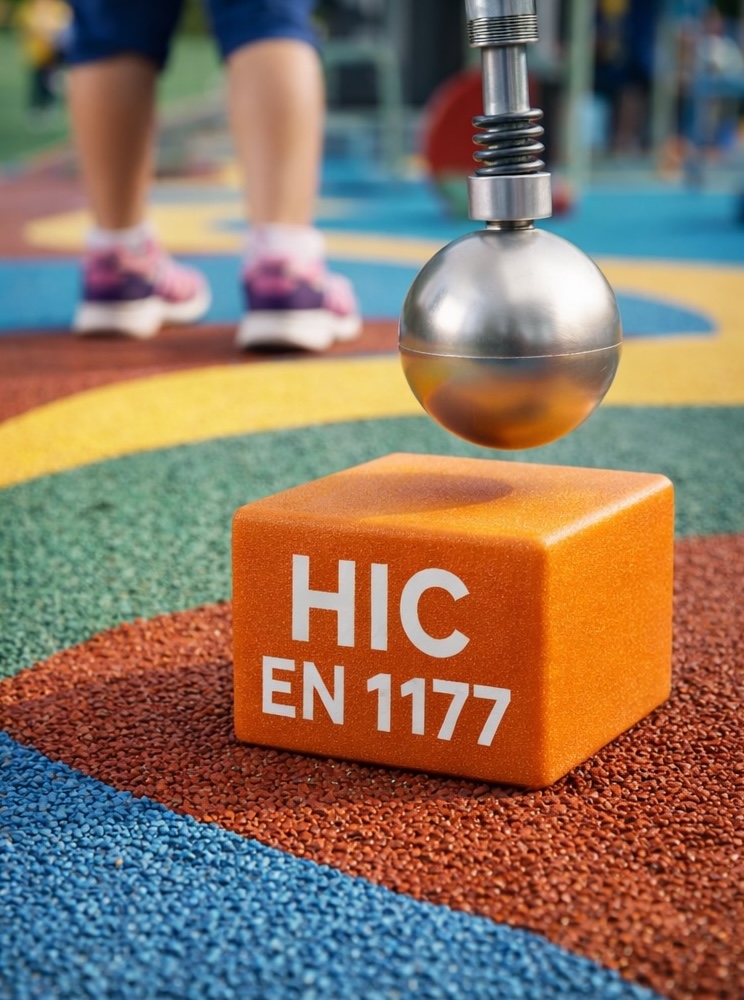
The test consists of dropping an instrumented headform onto the surface and measuring the deceleration on impact. Two values are obtained:
A surface fails if either limit is exceeded. The critical fall height of a surface is the lowest height at which the HIC reaches 1,000 or the gmax reaches 200 g. To be suitable, a surface must have a critical fall height at least equal to the free height of fall of the equipment.
For a poured-in-place surface, impact attenuation depends on the total thickness (base layer and top layer), the material, the binder ratio and the substrate. The values below are those of Terraludis systems, established in the laboratory to EN 1177, on a concrete slab.
Two-layer Calzado (including the 10 mm top layer)
Natural cork
Indicative values established on a concrete slab (for Calzado, higher on unbound sub-base or asphalt). For EPDM and other systems, ask for the test report matching the proposed configuration. Thickness, binder ratio and laying conditions are adapted to each site by the installer. Details on our Calzado and cork safety surfacing pages.
For drafting specification clauses, see our article on specifying circular safety surfacing.
Rules vary from country to country. In France, decree no. 96-1136 requires a suitable impact-absorbing surface wherever a child may fall, and EN 1176 and EN 1177 are the recognised means of demonstrating compliance. They are widely referenced in public tenders.
The acceptance test on the finished surface is organised by the installer, who controls the thickness, binder ratio and installation. It is carried out by a body or technician equipped with an instrumented headform.
Not automatically. Wear, cold, compaction or poor maintenance can reduce impact attenuation. A periodic check confirms that the surface still covers the fall height of the equipment.
For low fall heights, EN 1176 accepts certain natural surfaces. Above that, a material with demonstrated performance is needed: poured-in-place surfacing, artificial grass on a shock pad, tiles or loose-fill materials of sufficient depth.
Terraludis helps you define the right thickness for the fall height of your equipment. For projects outside France, we provide remote technical support and your local contractor carries out the installation; in France, we can refer you to a partner installer. Request a technical review or a quote · Technical data sheets