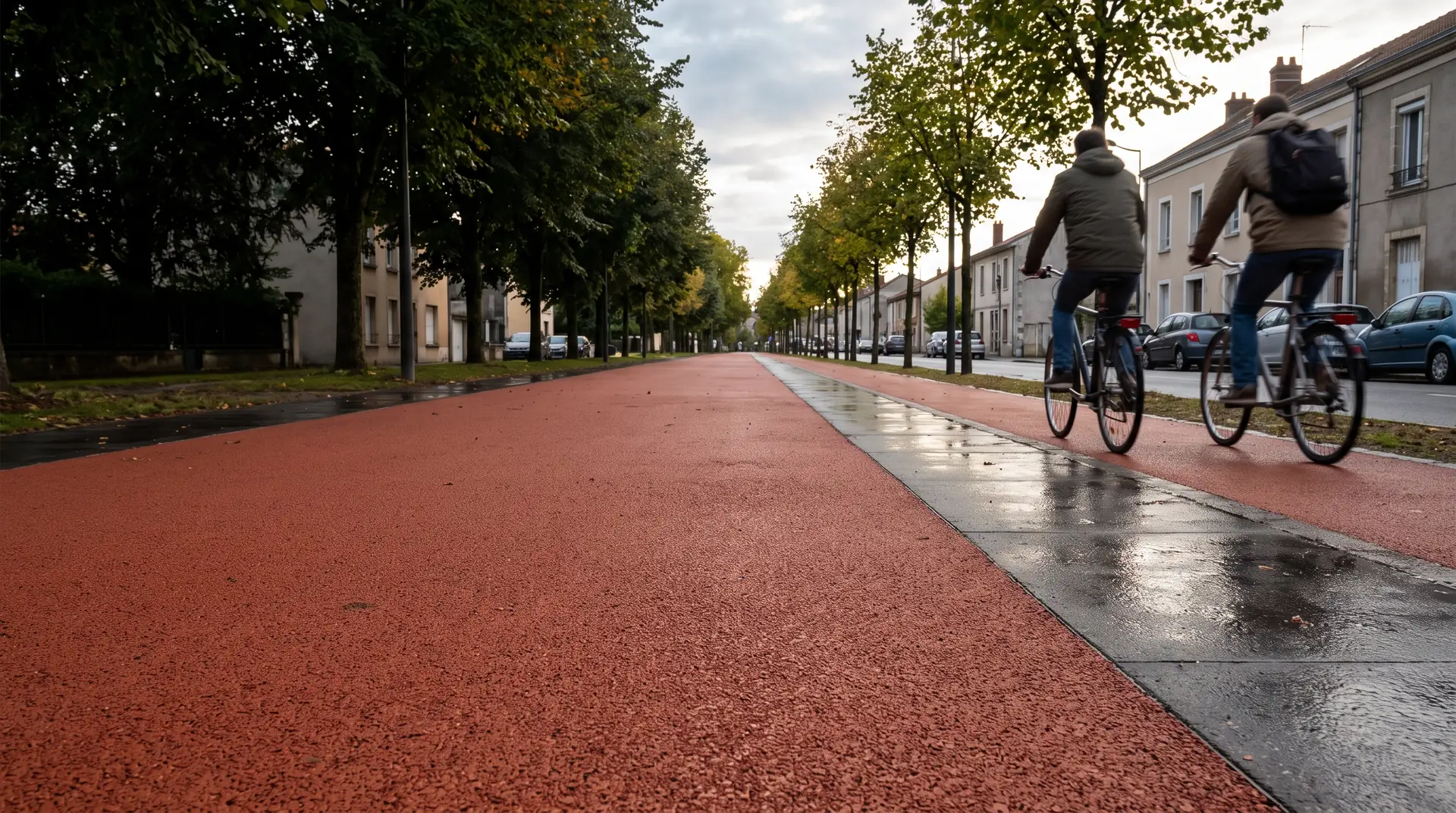
Red permeable bike path along a tree-lined avenue, with two cyclists

Cycle paths · Urban roads

Cycle paths and urban roads: cold-applied permeable surfacing

Permeable elastomer mortar in ECP or Calzado, cold-applied, including over existing surfaces: provides riding comfort, drainage, and noise reduction, from 8 to 50 mm per layer depending on use.

8 to 50 mm
per layer, depending on use
Cold-applied
no heating or thermal coating required
Draining
vertical drainage, less runoff
Renovation
minimal intervention on existing substrates

Illustrative image for reference only.

Key features of the surfacing

The TERRALUDIS surfacing combines hydraulic, environmental, and functional features to meet the needs of public development projects, whether new or renovated.

Water management

  • Permeable surface
  • Vertical drainage
  • Runoff reduction

Environmental performance

  • Cold-applied
  • Low energy installation
  • Reduction of thermal constraints on site

User comfort and safety

  • Riding comfort
  • Noise reduction
  • Wet-weather grip

Performances mesurées

Un mélange de granulat élastomère, de granulats minéraux et de résines, appliqué en couches de 8 à 50 mm. Voici les résultats d’essai du système de référence.

Propriété mesuréeNorme de référenceRésultat
Épaisseur d’applicationSpécification techniqueDe 8 à 50 mm par couche
Dureté superficielleEN ISO 868Supérieure à 95 Shore A
Absorption des chocs (HIC)EN 1177:2018Hauteur de chute critique : 0,97 m
Résistance au glissementEN 13036-4:2010Valeur au pendule : 57
Module de rigiditéEN 12697-26764 MPa
Valeurs issues du manuel technique du fabricant du système de référence, mesurées sur un mortier élastomère bicomposant à base de caoutchouc de chaussure (plus de 50 % de la composition), de granulats minéraux et de résines. Elles dépendent de la formulation et de l’épaisseur. Les rapports d’essai sont disponibles sur demande.

Deux options pour le composant élastomère

Le revêtement peut être réalisé avec un granulat SBR encapsulé (ECP) ou avec le granulat PCE Calzado, selon le budget et la stratégie environnementale du projet.

Granulat SBR encapsulé

ECP

Origine du granulat

Granulat issu de pneumatiques recyclés, encapsulé en couleur.

Points forts
  • Solution économiquement optimisée
  • Rendu coloré homogène
  • Option photocatalytique NOx possible, par encapsulation du TiO₂
Demander un chiffrage ECP
Système circulaire

PCE Calzado

Origine du granulat

100 % issu de chutes de production de semelles de chaussures.

Points forts
  • Filière traçable et homogène
  • Analyses INESCOP sous les seuils européens
  • Même famille de matière que le système de référence testé ci-dessus
Demander un chiffrage PCE

Pavement principle

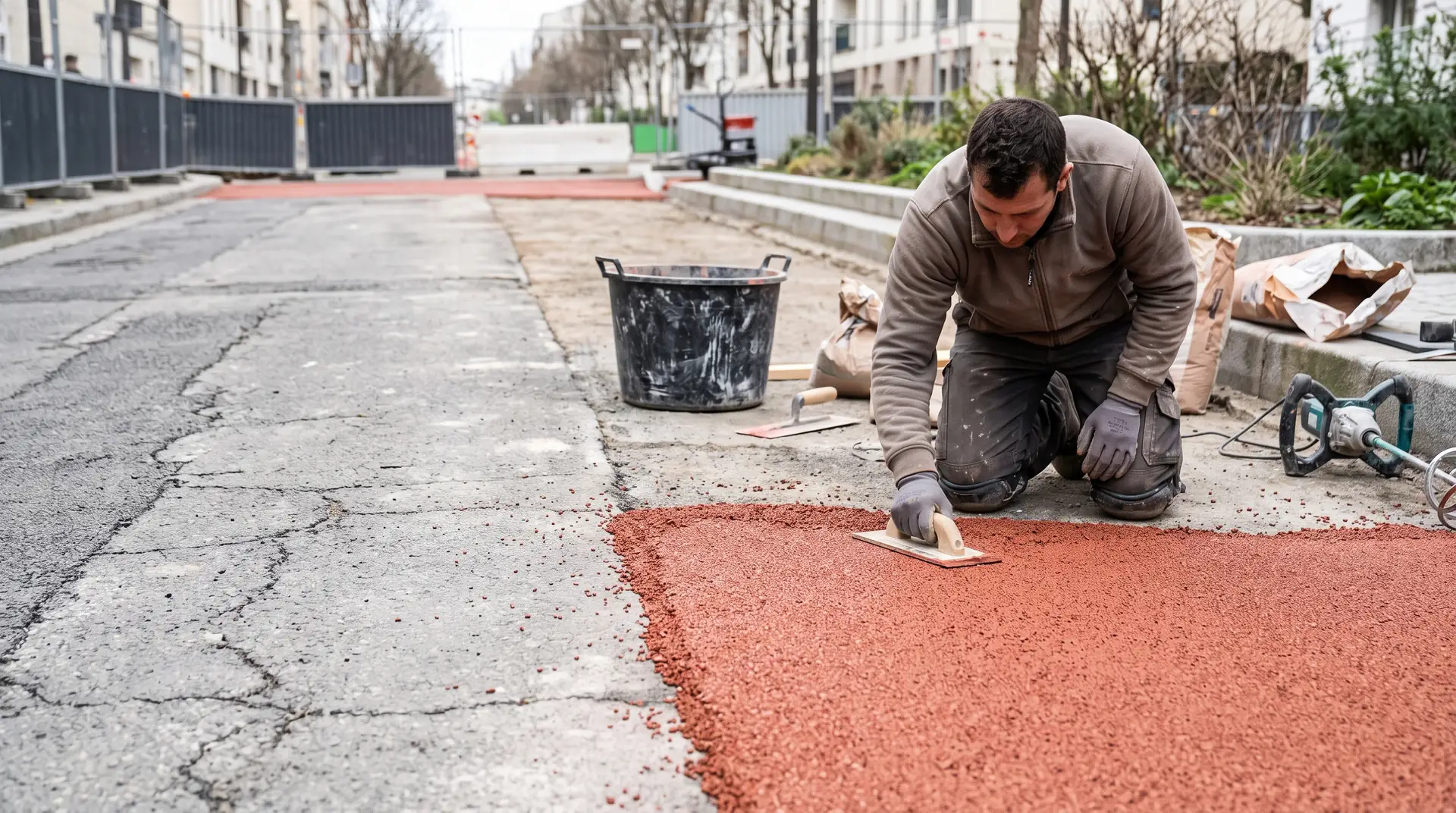
Applicator smoothing the red permeable pavement over existing cracked asphalt

Cold application on existing asphalt: a lightweight intervention without the need for full planing.

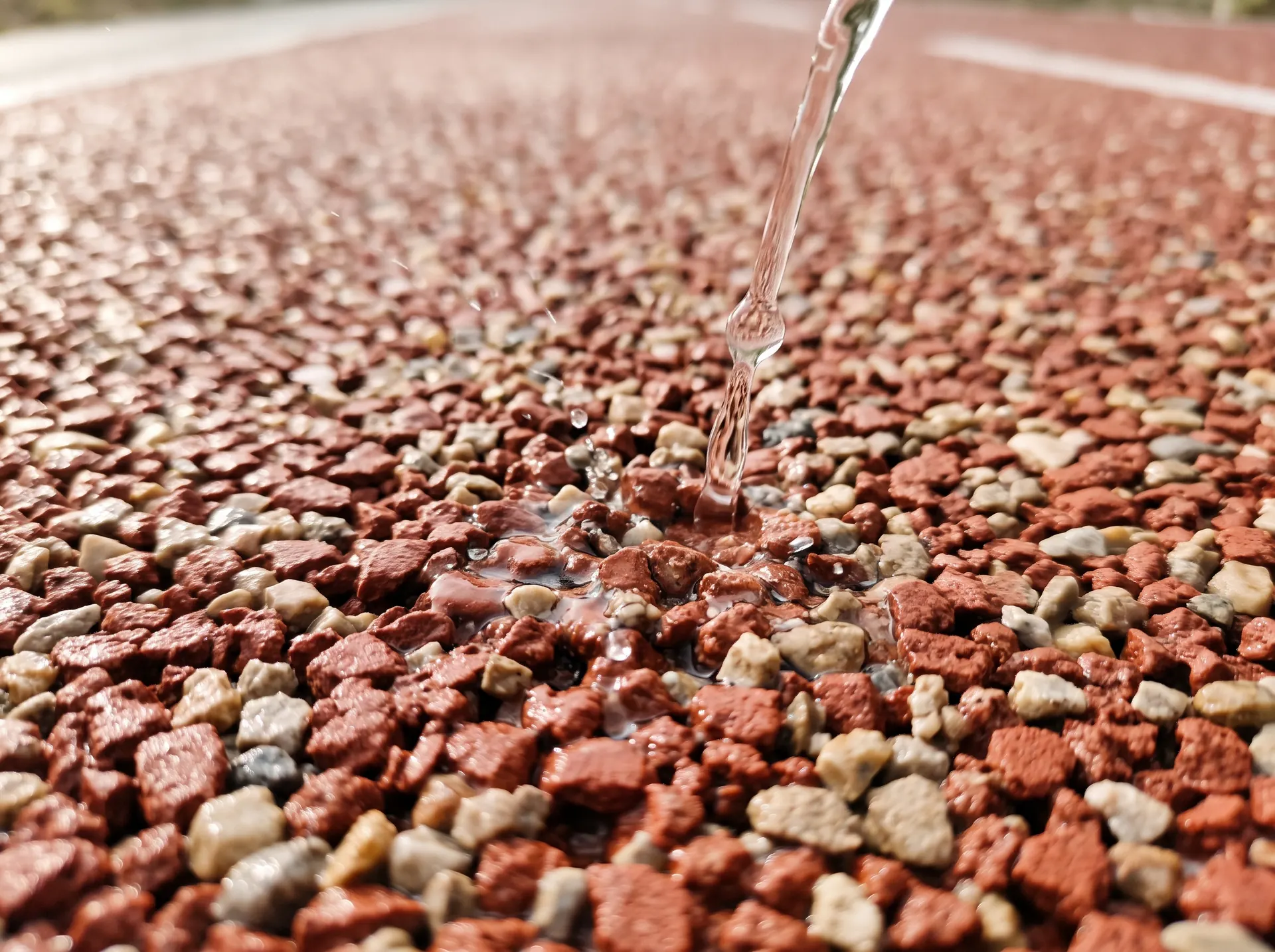
Water poured onto the permeable pavement, absorbed between the aggregates

Vertical drainage: water passes through the pavement instead of running off the surface.

Cross-section of a permeable cycle path made of encapsulated aggregates on a concrete base

Cross-section of the system: elastomer component, mineral aggregates, and polymer binder.

Illustrative images are not contractually binding.

System construction logic

  • a recycled elastomer component that provides flexibility, vibration absorption, and tolerance to existing substrates
  • selected mineral aggregates that guarantee mechanical stability, abrasion resistance, and controlled surface texture
  • a polymer binder that ensures mixture cohesion, pavement durability, and controlled transmission of rolling loads.

Hydraulic performance and permeability

The pavement structure is permeable, allowing for:
  • vertical water drainage at the surface level
  • limited surface runoff and water stagnation
  • maintained grip and riding comfort in wet conditions.

Implementation and site integration

The coating is applied cold, without heating or thermal coating processes, which allows for:
  • reduced energy impact of the construction site
  • installation compatible with constrained urban environments;
  • lightweight application, suitable for renovating existing substrates under certain conditions.

Functional performance

Due to its flexible nature and controlled grain size, the coating offers:
  • superior riding comfort compared to rigid surfaces;
  • reduced rolling noise;
  • a continuous and uniform surface, ideal for active mobility and shared pathways.

Positioning in public projects

The TERRALUDIS coating is designed as an operational solution intended to expand the range of surfacing options available to project owners and contractors, particularly in contexts where traditional solutions reach their limits:
  • renovation projects;
  • areas sensitive to noise or specific usage requirements;
  • developments with high requirements for urban integration.

Advanced environmental option: photocatalytic functionalisation

In addition to the mechanical, hydraulic, and functional performance of the coating, TERRALUDIS can incorporate an active environmental functionalisation option based on the inclusion of titanium dioxide (TiO₂) photocatalysts. This option aims to reduce nitrogen oxides (NOx) in the ambient air through a light-activated photocatalytic oxidation process.

Principles of photocatalysis applied to coatings

Titanium dioxide (TiO₂) is a recognised photocatalyst capable, under the action of light radiation, of causing the oxidation of certain atmospheric pollutants, particularly nitrogen oxides (NOx), into more stable and less harmful compounds.
  • NOx present near the surface is captured upon contact with the coating;
  • the photocatalytic process promotes their chemical transformation;
  • the by-products are then removed by natural leaching (rainwater).

Integration process: functional encapsulation of the photocatalyst

Unlike solutions based on a simple surface treatment, the TERRALUDIS approach relies on a process of integrating the photocatalyst into the heart of the system through controlled encapsulation:
  • integration of TiO₂ within the polymer binder and the encapsulation system of the elastomer component (SBR);
  • homogeneous dispersion of the photocatalyst within the coating matrix;
  • maintenance of the floor's mechanical and grip properties.

Technical benefits of encapsulation

This integration method offers several key technical advantages:
  • Durability of the photocatalytic function, less sensitive to surface abrasion;
  • Protection of the photocatalyst against mechanical and chemical wear;
  • Active function distributed throughout the functional thickness of the coating, rather than limited to a fragile surface layer.

Positioning and usage framework

This option is part of a strategy of controlled environmental innovation, suitable for pilot projects, urban developments with high traffic exposure, or operations incorporating air quality goals.
It allows TERRALUDIS to offer:
  • an advanced technical response to air quality policies;
  • a solution consistent with sustainable city initiatives;

Planning a cycle path or urban walkway?

Get a system data sheet