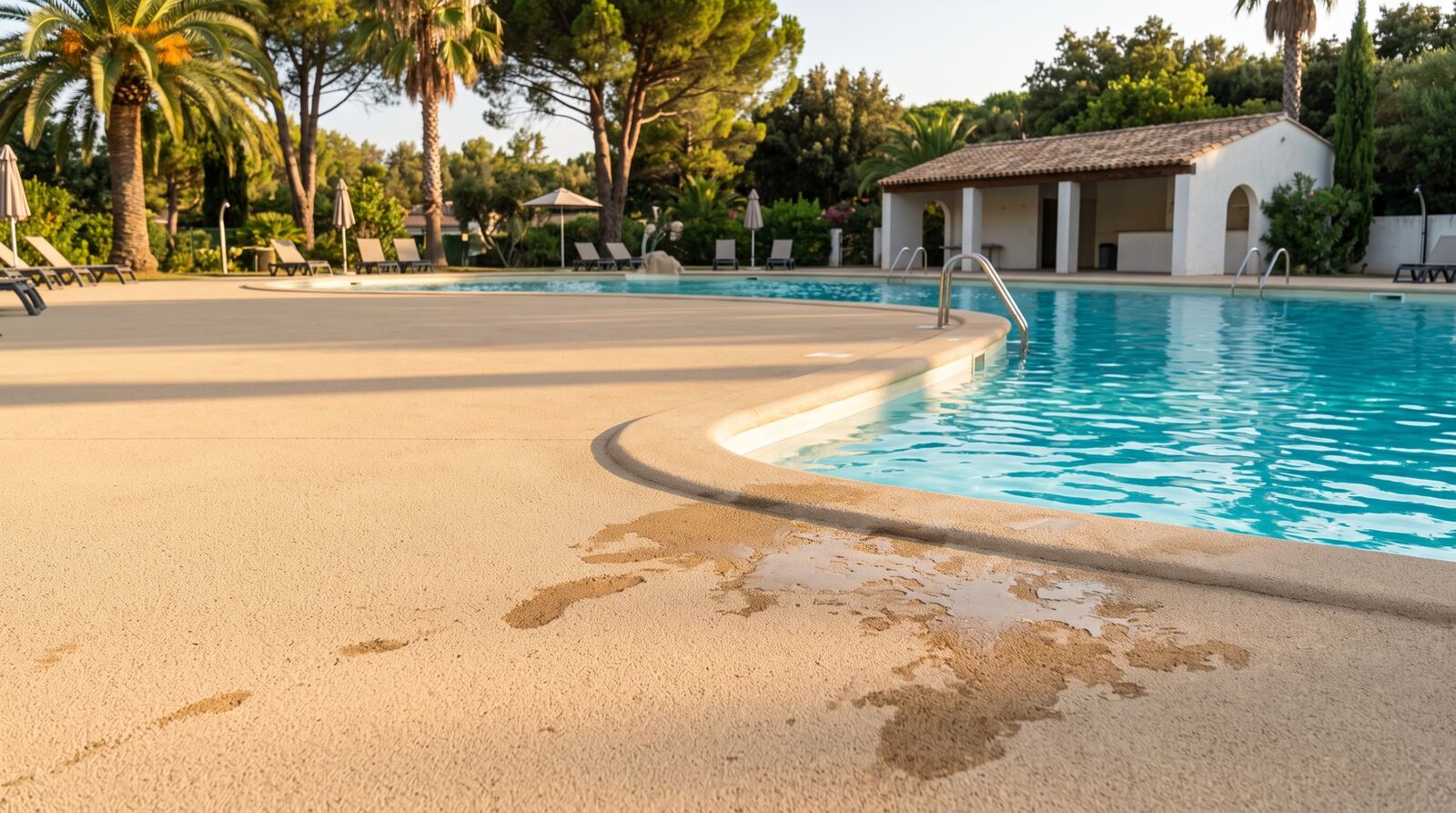
Pool deck with seamless, textured, joint-free surfacing

Textured polyurea · Stone carpet

Surfacing for pool decks and leisure pools: seamless, non-slip, barefoot-friendly

Pool decks, pool surrounds, paddling pools, and lagoons: Terraludis Systems provides seamless surfacing solutions tailored to the substrate, usage, and water exposure, available in textured waterproof polyurea or draining stone carpet.

Seamless
seamless, waterproof polyurea membrane
Barefoot
non-slip and comfortable texture for wet areas
2 processes
hot or cold-applied polyurea, depending on the project
Draining
or waterproof: stone carpet or polyurea depending on requirements

For illustrative purposes only.

Pool decks and outdoor basin surrounds

Pool decks and basin surrounds are particularly sensitive areas: they involve barefoot traffic, alternating wet and dry conditions, UV exposure, and repeated mechanical stress. An unsuitable coating can quickly become slippery, uncomfortable, or damaged.

The solutions developed by Terraludis allow for the creation of continuous, textured, and non-slip pool deck surfaces, offering:

Zones de finition spécifiques

Traitement de zones ciblées : transitions, bords, détails et surfaces nécessitant une finition particulière.

Reprises localisées

Réparation ou reprise ponctuelle : défauts, impacts, joints techniques, zones usées ou contraintes chantier.

Mise en œuvre plus souple

Application progressive selon l’accès, le phasage du chantier ou des contraintes de planning et de conditions météo.

These systems are suitable for public swimming pools, campsites, and leisure centres, as well as more complex landscaping projects involving free-form pools.

Polyurea process: hot-spray application and cold-applied solutions

Terraludis aquatic space coatings are based on polyurea systems, selected and applied according to the specific constraints of each project.

Hot-sprayed polyurea

Hot-sprayed polyurea creates a continuous, waterproof, and seamless membrane that is perfectly suited for leisure pools, paddling pools, and lagoons. It conforms to complex shapes, accommodates slopes, and ensures excellent continuity between different areas (floors, beach entries, and vertical surfaces).

Cold-applied polyurea solutions

Cold-applied solutions complement hot-spray application, particularly for:
  • specific finishing areas,
  • localised repairs
  • projects requiring more flexible or gradual implementation.

The choice between hot or cold application is made on a case-by-case basis, depending on the pool configuration, the substrate, project timelines, and finishing requirements.

Safety in wet areas and barefoot comfort

In an aquatic space, user safety relies largely on the management of surfaces in contact with water. Coatings must provide a precise balance between grip, comfort, and ease of maintenance.

Terraludis systems include:
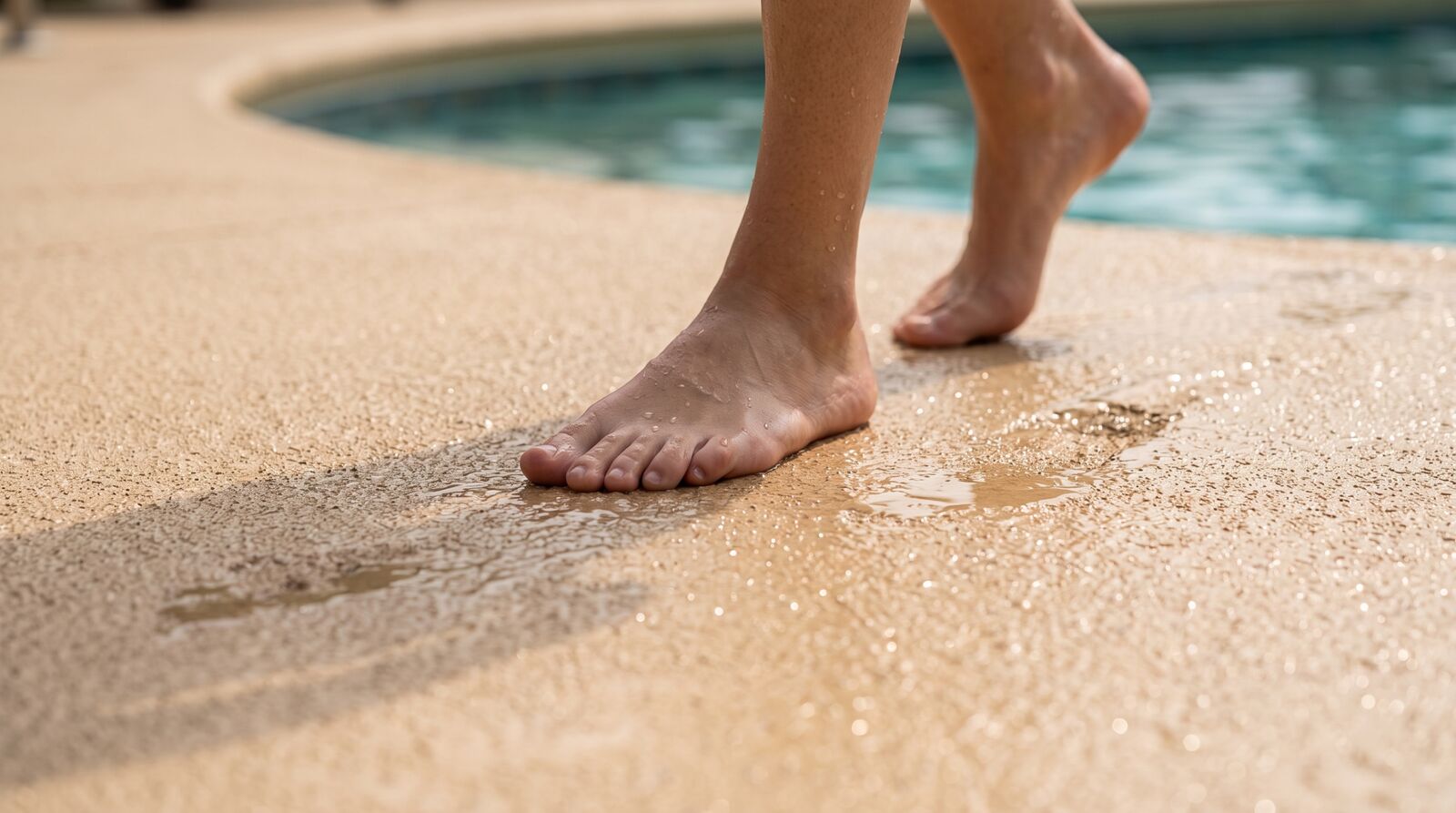
Bare feet on a wet, non-slip textured pool deck surface

Non-slip texture for wet areas, comfortable for bare feet · illustrative image

Textures adaptées aux zones pieds nus
Confort, grip et douceur de surface pour un usage fréquent en milieu humide.

Antidérapance maîtrisée
Performance maintenue en immersion, en éclaboussures et sur zones de circulation.

Surface continue, sans agressivité
Sans joints agressifs ni arêtes vives : circulation plus sûre et entretien simplifié.

This approach ensures safe movement while maintaining comfort, which is essential for play areas frequented by children.

Seamless waterproofing for aquatic environments

One of the major challenges for aquatic flooring is the long-term durability of the system. Poor continuity or an unsuitable coating quickly leads to leaks, peeling, or aesthetic degradation.

The polyurea coatings used in Terraludis systems offer:

  • seamless, joint-free waterproofing
  • high resistance to water and wet/dry cycles
  • excellent resistance to UV rays and standard chemical exposure
This continuity allows for simplified maintenance and greater longevity of the structures.

Compatible substrates and preparation for aquatic flooring

The performance of a pool deck or aquatic play area surface depends as much on the substrate as it does on the finishing material.

Terraludis systems are compatible with various substrates, provided they are properly prepared:

  • new or existing concrete
  • renovated mineral substrates
  • specialised structures incorporating slopes and free-form shapes
Substrate preparation (flatness, cohesion, suitable primers) is a decisive step, integrated from the project design phase.

A systems-based, independent, and prescriptive approach

Rather than offering a single product, Terraludis adopts a systems-based approach to coatings for aquatic spaces.

Each project is designed as a coherent whole combining:

  • substrate preparation
  • waterproofing system
  • textured finish adapted to the use
  • implementation and operational constraints
This prescriptive approach allows the solution to be precisely adapted to the site's actual usage, construction constraints, and the client's expectations.
Guide

Why choose a seamless coating for a pool surround?

The choice of a pool deck coating must take into account barefoot traffic, water splashes, sun exposure, humidity cycles, and maintenance operations. The selected system must be adapted to the actual use of the pool and the existing substrate.

01

Grip and safety in wet areas

A non-slip pool deck is defined based on tests adapted to the intended use and conditions of water exposure. Performance must be verified in the complete system documentation and, if necessary, during site acceptance conditions. No slip resistance class or value should be claimed without supporting documentation corresponding to the product and its use.

02

Barefoot comfort and sun exposure

Surface temperature depends on factors such as colour, sun exposure, material, and whether the surface is wet or dry. The choice of finish and colour must therefore be made according to the site; no coating can be guaranteed to remain cool under all circumstances.

03

Water drainage and slope design

Draining flooring and a waterproof pool deck serve different purposes. Drainage depends on the system structure, the substrate, the slopes, and the planned outlet. For a pool, it is necessary to distinguish between the circulation area around the water and the waterproofing system of the pool itself.

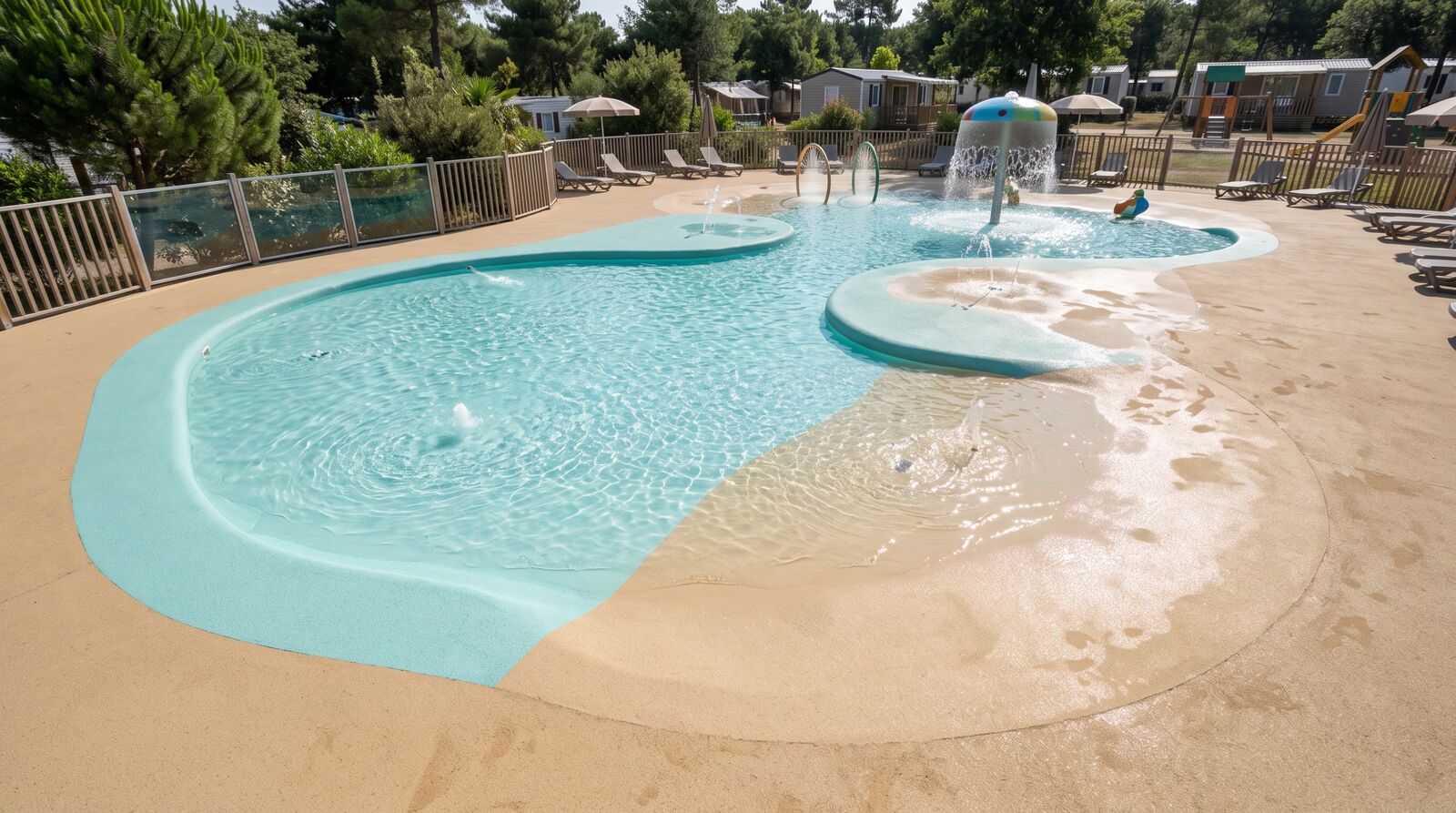
Textured polyurea paddling pool and lagoon with a gently sloping beach at a campsite

Paddling pools and lagoons

Free-form shapes, gentle beach-style entry, textured and waterproof bottom: polyurea follows the curves of the pool without joints, from the edge to the floor.
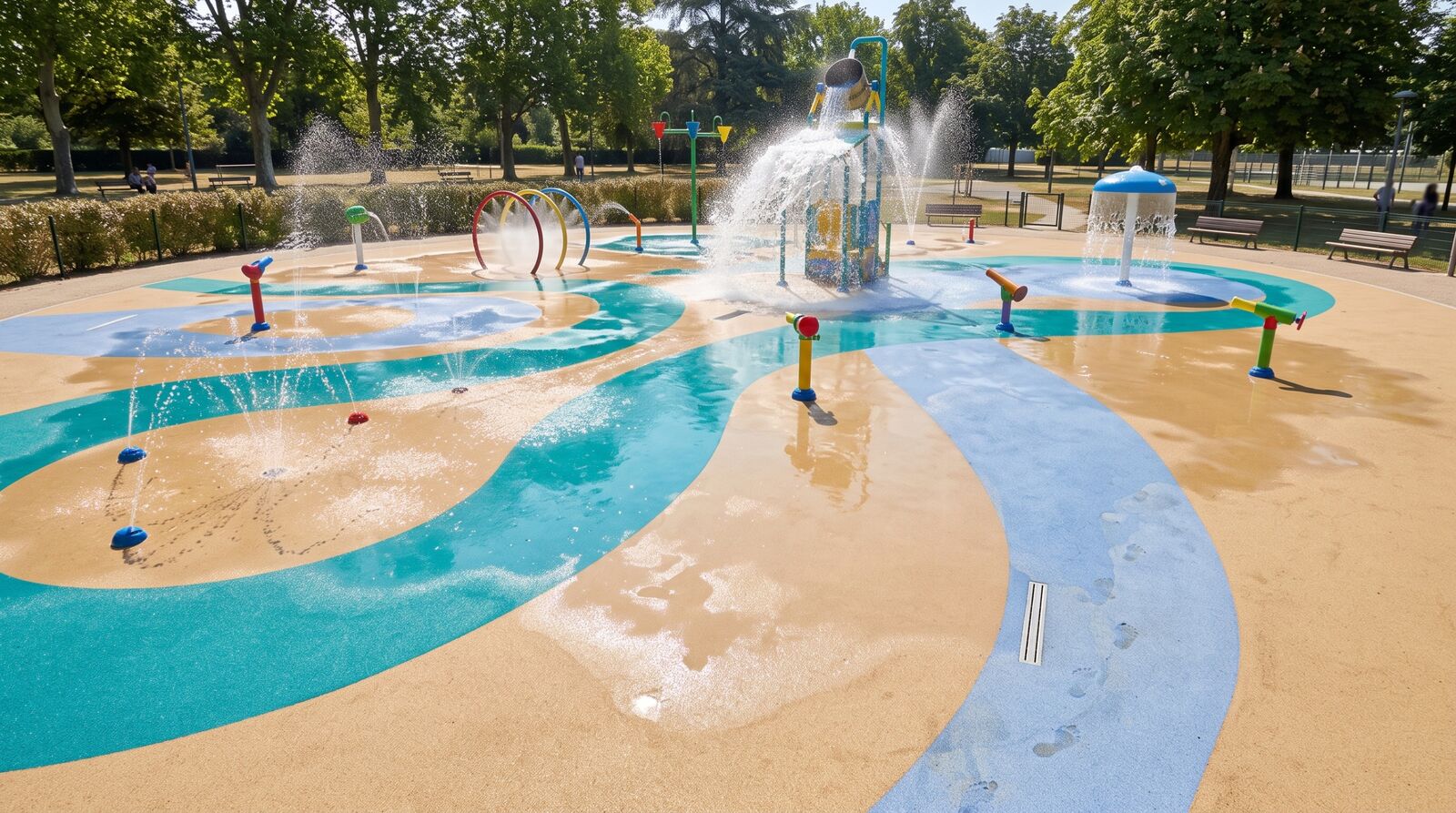
Municipal splash pad with jets, tipping bucket, and two-tone textured seamless flooring

Splash pads

Ground jets, misting arches, tipping buckets: a seamless, non-slip, coloured coating with slopes towards drains for splash parks that are safe and easy to maintain.

Resin and soft flooring for aquatic areas

Textured polyurea for pools, paddling pools, and decks

Terraludis polyurea-based systems are designed for aquatic projects where continuity, waterproofing, and a textured finish are key requirements. The process (hot spray or cold-applied solution), layers, and connection details are determined by the configuration and the system's technical specifications.

EPDM and finishing resins: check the intended use

EPDM soft flooring, polyurethane resin, and polyurea membranes are not interchangeable. Their use near a pool must be validated based on permanent or intermittent water exposure, treatment chemicals, UV resistance, desired grip, and manufacturer specifications. Compatibility with chlorine or salt must be confirmed by the technical documentation of the chosen system.
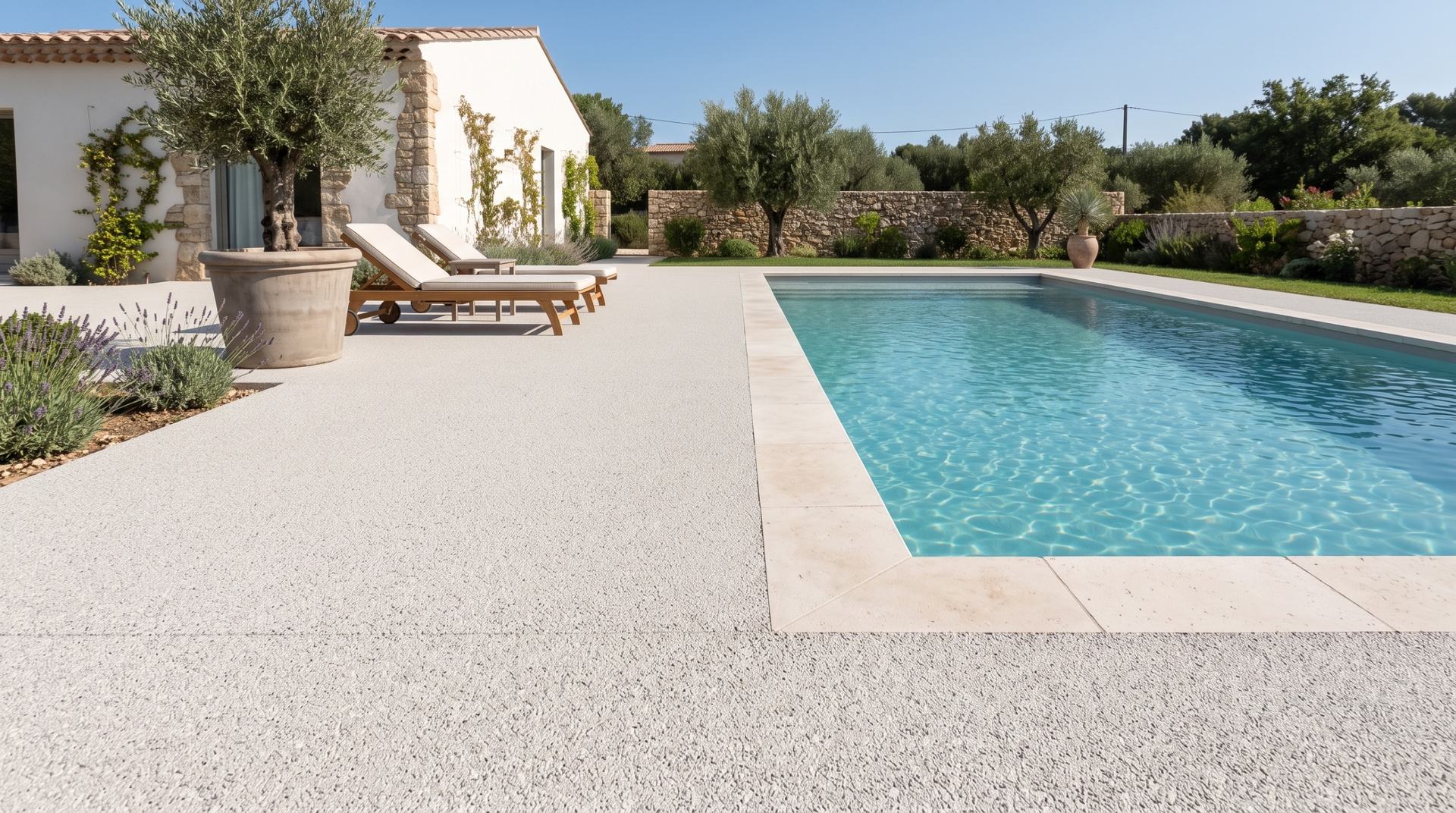
Permeable stone carpet pool deck, Lagon blend

Permeable pool deck · Lagon blend

Need water to drain through? Choose stone carpet

Natural aggregates bonded with TL-Stone2800 aliphatic resin: a permeable, non-yellowing coating, available in Lagon or Dune blends for pool surrounds.

Discover our permeable flooring →

Renovation: can you resurface an old pool deck?

Renovating a pool deck can sometimes be done over an existing surface, but direct application over tile, concrete slabs, or paving cannot be guaranteed without a professional assessment. You must check for cohesion, moisture, flatness, cracks, the adhesion of old coatings, and any hollow-sounding areas. Appropriate preparation and a primer may be required; in some cases, removal remains necessary.
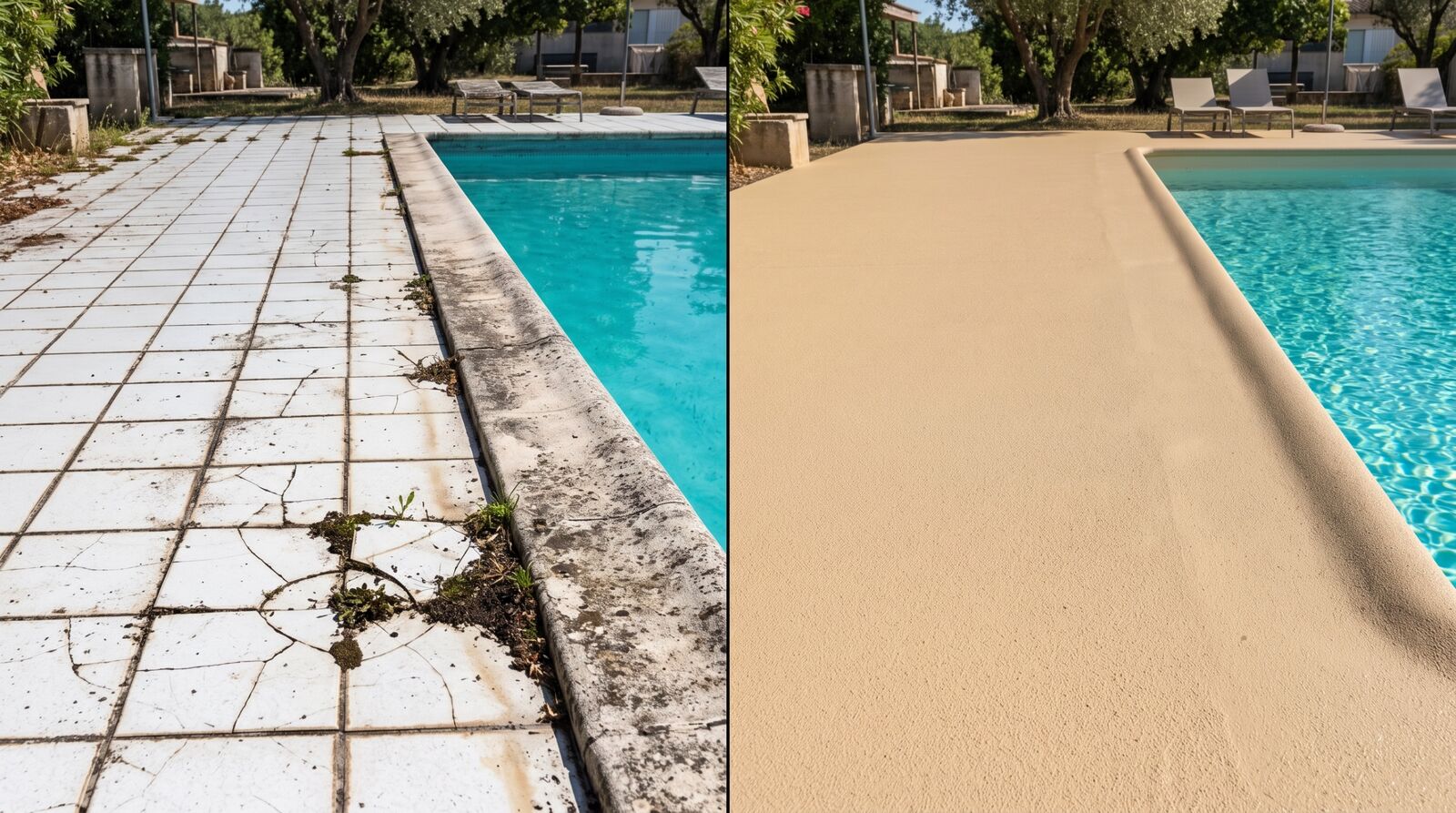
Before and after pool deck renovation: cracked tile replaced by a textured seamless finish

Before / after: cracked tile and overgrown grout, followed by a seamless, joint-free finish · illustrative visual

Poured flooring, tile, wood, or concrete: which criteria should you compare?

SolutionKey points to considerPrecautions
Poured resin surfacingContinuity, connection details, finish, and maintenanceSystem compatibility, substrate preparation, and slip resistance in wet conditions
TileTile selection, aesthetics, and repairabilityBarefoot grip, joints, aging, and maintenance
WoodNatural appearance and comfort depending on the species and installationMoisture, potential splinters, maintenance, and long-term stability
ConcreteDurability and variety of finishesSurface texture, cracking, heat retention, and surface treatments

Comparisons should be based on complete systems installed under similar conditions, rather than on the surface material alone.

Maintenance and durability of pool surrounds

Maintenance protocols depend on the finish, texture, level of soiling, and manufacturer recommendations. Use cleaning products and pressure levels compatible with the installed system. Do not assume that high-pressure cleaning, fungicide treatments, or any chemical products are suitable without technical validation.

FAQ — Pool deck surfacing and pool surrounds

Le prix dépend du système, de la surface, de l’état du support, des préparations, des relevés, des détails de raccordement et des contraintes d’accès au chantier. Un chiffrage fiable nécessite les caractéristiques du projet et un diagnostic du support.

La compatibilité dépend de la formulation, de la finition et du type d’exposition. Elle doit être confirmée dans la fiche technique du système retenu, notamment pour les projections répétées ou les zones exposées aux produits de traitement concentrés.

L’épaisseur varie selon le système, la fonction recherchée et le support. Elle doit être définie dans la documentation de mise en œuvre et le descriptif technique du projet ; il n’existe pas de valeur unique valable pour tous les revêtements de piscine.

Oui, avec une moquette de pierre : des granulats naturels liés par une résine polyuréthane aliphatique qui laisse l’eau s’infiltrer dans le revêtement au lieu de ruisseler. Elle se pose sur un support stable, avec une pente d’au moins 1,5 % et un exutoire prévu.

Pour un bassin ou une zone en immersion, on choisit au contraire une polyurée étanche.

Un bassin ludique (lagon, pataugeoire, zone splash) combine généralement étanchéité, texture et confort pieds nus sur des formes libres et des zones en contact permanent avec l’eau.

Une plage ou un contour de piscine est plutôt une zone de circulation humide et sèche : on privilégie une adhérence maîtrisée, une bonne tenue UV et une texture adaptée à l’entretien, sans forcément être en immersion.

La polyurée projetée à chaud permet une membrane continue, rapide à appliquer, très adaptée aux bassins, pataugeoires et lagons avec relevés et points singuliers.

Les solutions à froid sont souvent privilégiées pour des finitions, des reprises localisées ou des mises en œuvre progressives selon l’accès et le phasage du chantier.

La sécurité repose sur le bon compromis entre texture, confort et entretien. En pratique, on définit la rugosité et la finition selon les zones : adhérence contrôlée en éclaboussures sur les circulations et abords, texture plus confortable sur les zones pieds nus, finition adaptée à l’usage et au nettoyage dans les zones en immersion.

Une surface continue limite aussi les risques liés aux joints et aux arêtes.

Le support doit être stable, cohésif et préparé : planéité, pentes, évacuations, traitement des points singuliers. La préparation et le primaire sont choisis selon le contexte : neuf ou rénovation, humidité, porosité.

La performance finale dépend autant du système que de la qualité de préparation et de mise en œuvre.

Les zones aquatiques subissent des cycles humides et secs, les UV et une fréquentation élevée. Une surface continue facilite l’entretien et limite les zones sensibles.

Pour maîtriser la durabilité, on anticipe une texture cohérente avec le niveau d’usage (circulation, jeux, repos), des finitions compatibles avec l’exposition UV et un plan de maintenance simple : nettoyage régulier, contrôles visuels, retouches si besoin.

Oui, selon l’état du support et la nature des désordres. Des interventions ciblées sont possibles : reprises localisées, re-texturage, mise à niveau ponctuelle et remise en conformité de détails.

Une visite technique permet de valider la préparation, les zones à reprendre et le scénario de rénovation le plus rationnel.

Planning a leisure pool or pool deck project?

Request a quote