Meet us at the Salon des Sports et Parasports·Hall 7.1, stand H34, 24–26 November 2026Book a meeting →

Sports surfaces · footwear industry
Between painted asphalt—hard and economical—and poured rubber (10 to 15 mm), which is flexible but heavy, lies a 1.5 to 3 mm surface that cushions impact without altering court dimensions. An elastic layer derived from the footwear industry, applied in 1 to 3 coats beneath an acrylic tennis court finish. Suitable for tennis, padel, pickleball, basketball, and multi-sport use.
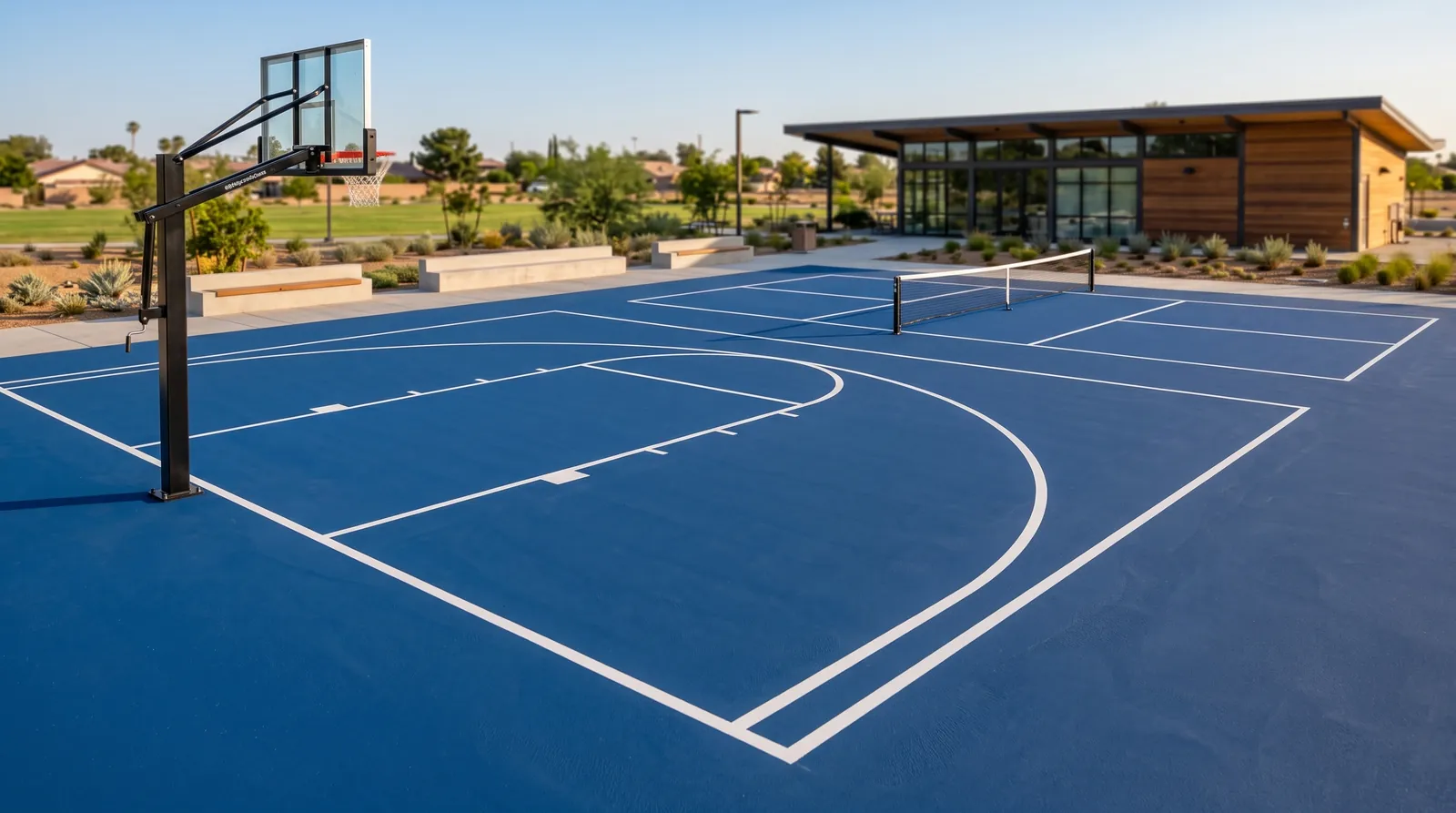
Illustrative image for reference only.
1.5 – 3 mm
total thickness depending on composition, 5 or 7 layers
Shore A 65
elastic layer hardness (± 10), high elasticity
−30 to +90 °C
operating range, resistant to weather, frost, and UV rays
EN 14877
compliant with all tests performed in an independent laboratory
The elastic layer uses the same Calzado material as in our brochure: production offcuts from shoe soles, sourced from identified European industrial streams. Pre-consumer material, free of road residues, with a fully traceable supply chain. This system was developed with our partners in the European industry.
A flexible elastic layer underfoot that supports your movements, running, and landings.
A finish resistant to wear and UV rays. The system withstands harsh weather and frost, with an operating range of -30°C to +90°C.
The same surface can accommodate markings for multiple sports: tennis, padel, basketball, multi-sport, and pickleball. Markings and finish: choice of RAL colours.
× 20
Calzado material, including the powder form used for sports, has undergone toxicological analysis by INESCOP, a leading European technology centre for the footwear industry (report no. C-24041693).
All substances tested are below European regulatory limits, with most falling below the detection threshold. For PAHs, the measured content is at least twenty times lower than the REACH limit (Annex XVII, entry 50).
One system, five sports. The finish and markings change, but the elastic layer remains.
Rebound compliant with EN 14877 (97% measured), matt finish, white markings. Suitable for new asphalt surfaces or for resurfacing existing resin courts.
For concrete slabs, as a replacement for or addition to synthetic turf: a solid, sand-free surface that can be cleaned with a hose.
The sport on the rise is played on acrylic resin. A 20 × 10 m court can be marked out in a single day on an existing base.
Footwork, jumps, and landings: the elastic layer cushions joints without the mushy feel of a playground surface.
A single surface can accommodate multiple markings in distinct colours (tennis, basketball, volleyball, handball). Playing areas and run-offs in two shades.
Asphalt, concrete slab, or old porous concrete court: the system adapts, the preparation changes.
The standard substrate for poured sports flooring. De-oiled 0/6 asphalt (2 to 4 weeks for new asphalt), 0.8% to 1% slope for water drainage, 3 mm flatness under a 3 m straightedge.
Before application: water test, levelling of puddles with the intermediate layer.
Concrete at least 28 days old, dry, with no rising damp. Shot-blasted or sanded surface, bonding primer, expansion joints respected and bridged.
The cleanest surface for padel and pickleball.
Thousands of courts from the 70s to the 90s are made of porous concrete. There are three ways to refurbish them.
1. Repaint with microporous paint for porous concrete: the surface remains hard, and the process is repeated every 5 to 8 years.
2. Cover with a 4 to 5 cm 0/6 asphalt layer over the existing porous concrete, after adjusting slopes and verifying drainage, then apply Calzado Sport. Sustainable renovation: the structure is preserved, and the court becomes a flexible resin court.
3. Apply directly to porous concrete, only on sound substrates without open cracks, after high-pressure cleaning and anti-moss treatment, with several passes to seal the pores before the elastic layer. This is decided based on a substrate assessment: porous concrete breathes from underneath, and a sealed film can blister if moisture rises.
1.5 to 3 mm total depending on the composition, poured onto the substrate.
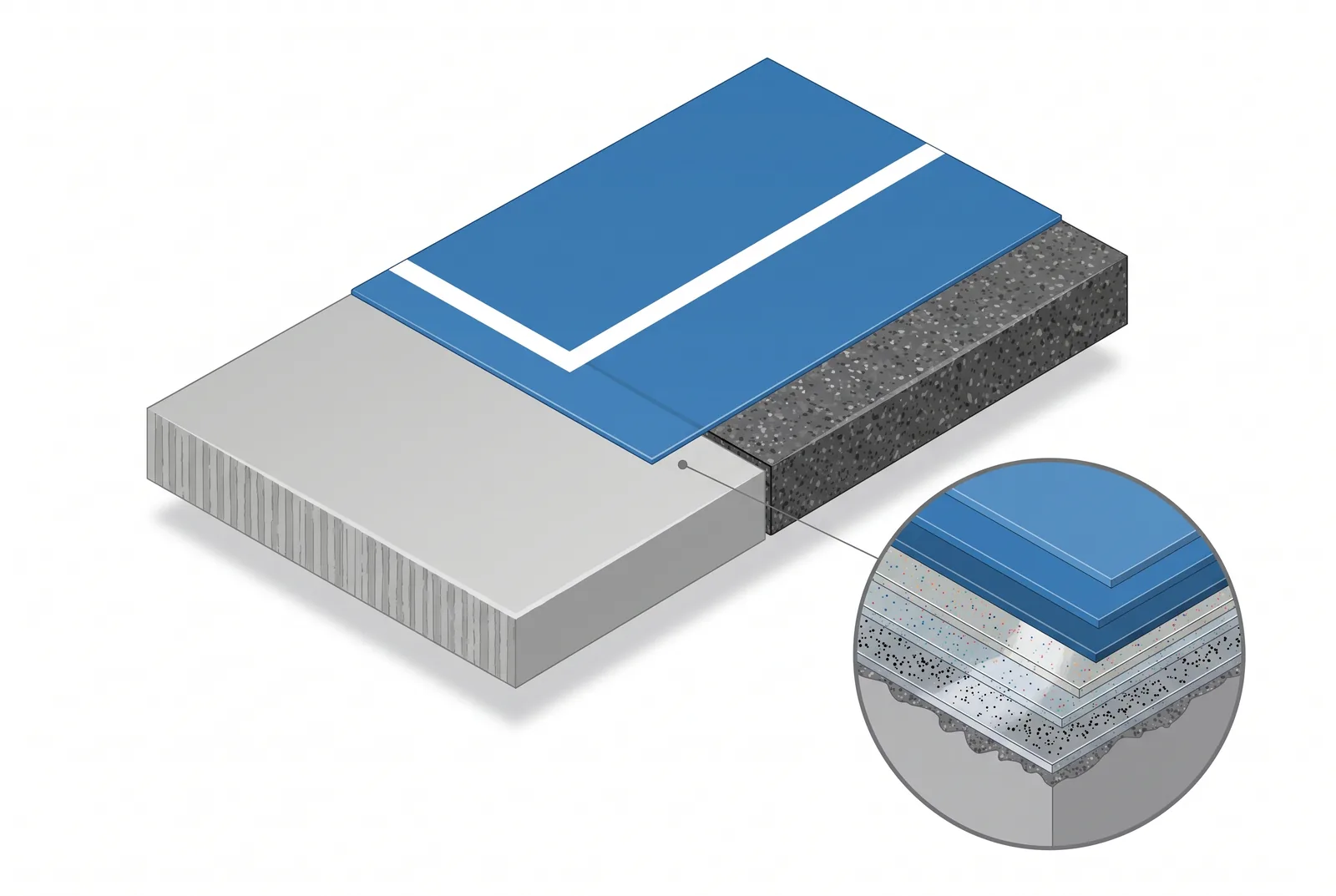
Concrete substrate
Asphalt substrate
Calzado elastic layer
After a bonding primer: resin filled with Calzado powder, applied in 1 to 3 coats depending on usage, 0.5 to 1.5 mm
Finish
Intermediate levelling layer, followed by two coats of coloured resin in the chosen RAL shade
Multi-sport court markings
Tennis, padel, basketball, multi-sport, pickleball
Schematic diagram, not to scale. Two compositions: 5 layers (1.75 kg/m²) or 7 layers (2.95 kg/m²). Consumption excludes substrate; thicknesses confirmed during the design phase.
Where does Calzado Sport sit between the acrylic paint of a hard court and the poured rubber of a playground?
Indicative values, common market systems.
Values for the Calzado elastic layer and the resin finish.
Source: partner specifications.
Standards and tests
Results obtained in an independent laboratory, compared to the requirements of the standard for outdoor synthetic sports surfaces.
Tests conducted by an independent laboratory in accordance with EN 14877:2014, October 2026, on a red finish system. Report available upon request.
Sur le terrain
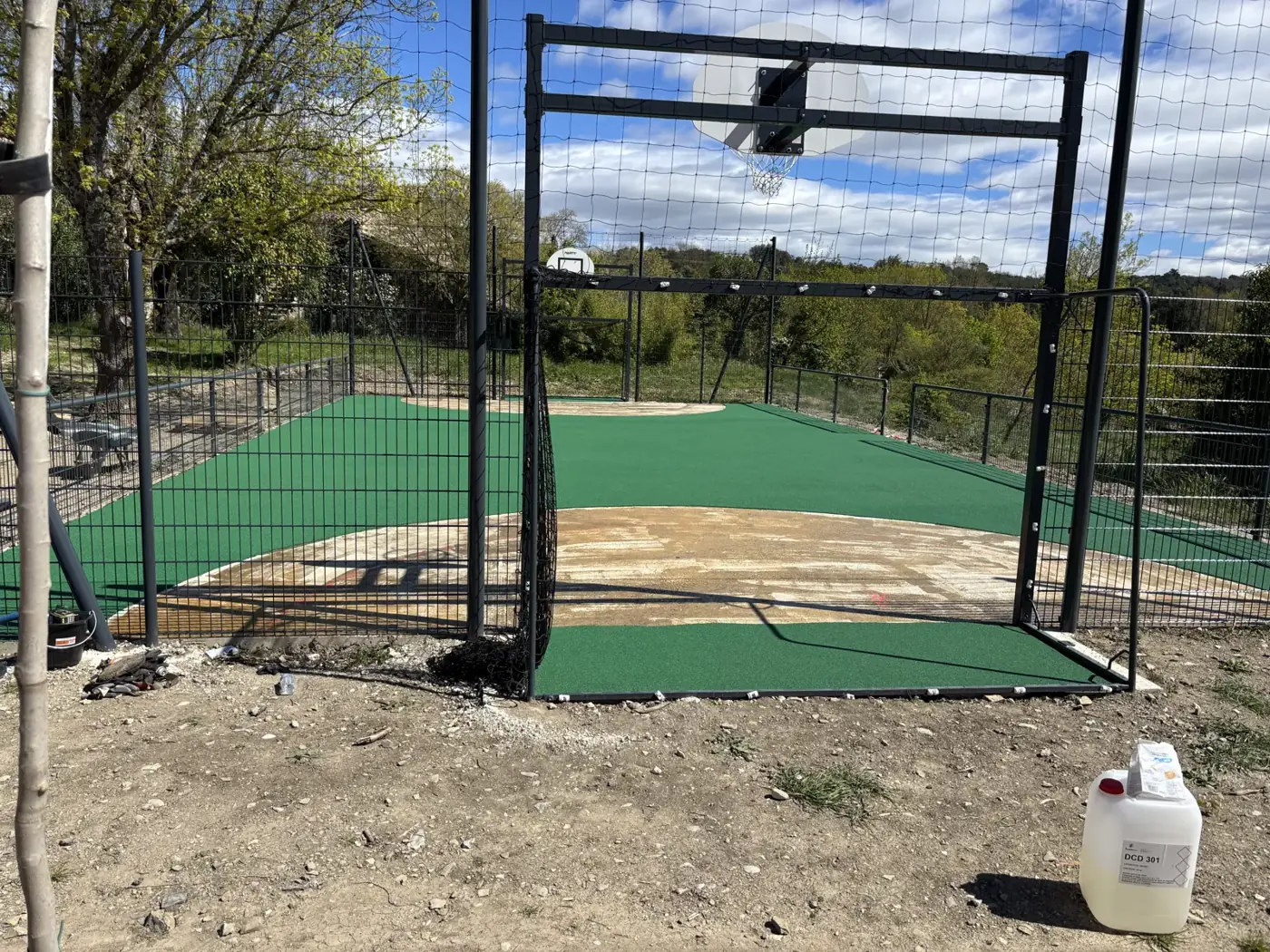
Terrain multisport, Gard (30), mars 2026 : 200 m² repris en revêtement souple Calzado de 10 mm, coloris vert, sur la dalle béton existante. Pose par un applicateur partenaire, matériaux Terraludis.
Ce chantier utilise la version épaisse du Calzado, celle des aires de jeux. Calzado Sport reprend la même matière en couche fine de 1,5 à 3 mm, sous une finition acrylique de court.
Vous avez un court en béton poreux à rénover ? Lire notre guide : Rénover un court de tennis en béton poreux : 3 solutions.
Un terrain multisport ou un city stade à remettre en état ? Lire notre guide : Rénover un terrain multisport ou un city stade : quel revêtement choisir ?
Frequently asked questions
Yes, but it must be done correctly. You can either cover the porous concrete with a 0/6 asphalt layer before applying the system, or apply it directly after assessing the base and filling the pores in several passes. In any case, a cracked or waterlogged "Quick" court must be treated first.
Paint alone is 0.5 mm thick, leaving the surface as hard as asphalt. Calzado Sport adds an elastic layer of shoe-sole powder under the same finish, providing the same bounce and maintenance, but with a surface that cushions impact.
Poured rubber is 10 to 15 mm thick, weighs 10 to 15 kg/m², and does not provide a standard ball bounce. Calzado Sport is 1.5 to 3 mm thick, can be installed over an existing surface without levelling, and plays like a hard court.
Yes. The finish can feature distinct colour markings for different sports and can be two-toned to differentiate the playing area from the surrounding space.
No, the system is sealed: water drains off via the slope of the base, which is between 0.8 and 1%. This ensures a smooth surface, consistent ball bounce, and easy cleaning with a hose.
Depending on temperature and humidity, the court can be marked 24 hours after the final coat and played on within a few days. The exact schedule depends on the specific site and the installer.
Like any acrylic resin court, the finish can be renewed with a simple fresh coat of paint; the elastic layer remains in place. Routine maintenance is done with water.
Terraludis supplies the material, the design study and the quantity survey. In France, we put you in touch with an installation contractor in your area; elsewhere, your own installer lays the system with our remote technical support. Pricing and execution of the works are the installer’s responsibility.
Finishing and court markings in your choice of RAL colours.
Trois familles dominent : la résine acrylique sur enrobé, dure et économique ; le gazon synthétique, confortable pour le foot mais moins adapté au basket ; le caoutchouc coulé de 10 à 15 mm, souple mais épais. Calzado Sport se place entre la résine et le caoutchouc : une finition acrylique sur couche élastique de 1,5 à 3 mm, avec le rebond d’un court en dur et des appuis amortis.
Oui, si l’enrobé est sain : nettoyage, reprise des fissures et des flaques, primaire, puis le système. Avec 1,5 à 3 mm, il n’y a pas de reprise de niveau : la structure, les buts et les paniers restent en place. Un enrobé déformé ou fissuré en profondeur se reprend d’abord, localement ou par une nouvelle couche.
Tout dépend de la pratique dominante. Si le foot domine, le gazon reste confortable, mais son remplissage se déplace et se tasse, et demande brossage et regarnissage. Pour un usage mixte (basket, hand, volley, tennis), un sol coulé fermé donne un rebond régulier à toutes les disciplines et se nettoie au jet. Si vous retenez le gazon, une sous-couche amortissante sous gazon synthétique apporte l’amorti.
Three pre-installation steps, managed by Terraludis.
System composition based on usage, sports, and surface type.
Material consumption, colours, and court layout plans.
In France, we pass your project to an installation contractor in your area; elsewhere, we support your own installer remotely.
Planning a court, padel court, or multi-sport area?
Request a study